Technology

Navigating the AI Revolution: Bridging the Skills Gap and Controlling Your Content

Navigating the AI Revolution: Bridging the Skills Gap and Controlling Your Content

The AI revolution presents a dual challenge: a growing digital skills gap and the need for content control. To address the skills gap, initiatives are training a new workforce for tech roles like data annotation. Simultaneously, to protect intellectual property, new tools from companies like Cloudflare and GoDaddy are empowering creators to control how AI uses their content. The article concludes that a balanced approach—investing in human skills while establishing technical safeguards—is essential for building an innovative and equitable AI-driven future.

Beyond Chatbots: Meet the AI Agents That See Your World and Plan Your Life

Beyond Chatbots: Meet the AI Agents That See Your World and Plan Your Life

Artificial intelligence is evolving beyond reactive chatbots into proactive **AI Agents**. These autonomous systems can perceive their environment, create multi-step plans, and execute tasks to achieve a goal without constant human input.

This shift is powered by multimodal models like Meta’s Muse Spark, which can process text, images, and audio. Applications such as The Nudge already use this approach to act as personal life planners. The main conclusion is that AI is becoming a collaborative partner that actively assists you, rather than just a tool that responds to commands.

The Entrepreneur’s Playbook: A Complete Guide to Developing Your First Product

The Entrepreneur’s Playbook: A Complete Guide to Developing Your First Product

This guide advises startups to use a Minimum Viable Product (MVP) to launch successfully. First, validate your idea through market research to ensure you are solving a real problem. Then, build an MVP—a streamlined version of your product with only the essential features. After launching, use the “Build-Measure-Learn” feedback loop: gather customer data and feedback to continuously improve the product. This iterative, customer-centric approach minimizes risk and helps create a product that users truly need, ensuring a more efficient path from idea to a successful launch.

The Modern Founder’s Playbook: Blending Human Grit with AI-Powered Growth

The Modern Founder’s Playbook: Blending Human Grit with AI-Powered Growth

To achieve startup success, founders must combine human resilience with AI-powered marketing. The article emphasizes building a strong foundation first through “grit”—creating a community before launching a product and demonstrating perseverance to investors.

Once this human-centric base is set, startups can scale using no-code AI to automate marketing. This includes developing content strategies, collecting customer testimonials, and generating personalized content. The main conclusion is that blending this resilient human foundation with intelligent technology is the key to massive, sustainable business growth.

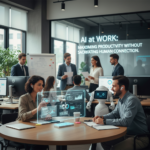
AI at Work: Maximizing Productivity Without Sacrificing Human Connection

AI at Work: Maximizing Productivity Without Sacrificing Human Connection

Personal AI assistants for inbox management boost productivity by automating routine tasks like drafting emails and retrieving information. This frees up employees for more strategic work. However, the article warns that over-reliance on AI can lead to social isolation and weaken workplace culture.

The main conclusion is that leadership must integrate AI intentionally. By using AI as an efficiency tool while actively protecting time for human connection, organizations can harness its benefits without sacrificing team cohesion. This strategic balance is crucial for a healthy and productive future of work.

Beyond Chatbots: How Specialized AI Agents Are Revolutionizing Professional Workflows

Beyond Chatbots: How Specialized AI Agents Are Revolutionizing Professional Workflows

GPT agents are autonomous AI systems that surpass simple chatbots. They can understand a goal, create a multi-step plan, and use digital tools to execute complex tasks.

Key applications include no-code app development, where agents build software from plain English commands, and cybersecurity, where they automate threat detection by analyzing data and writing security rules. The main conclusion is that the future of work will be agent-driven, with AI augmenting human professionals by handling complex tasks, freeing them up to focus on strategy and creativity.