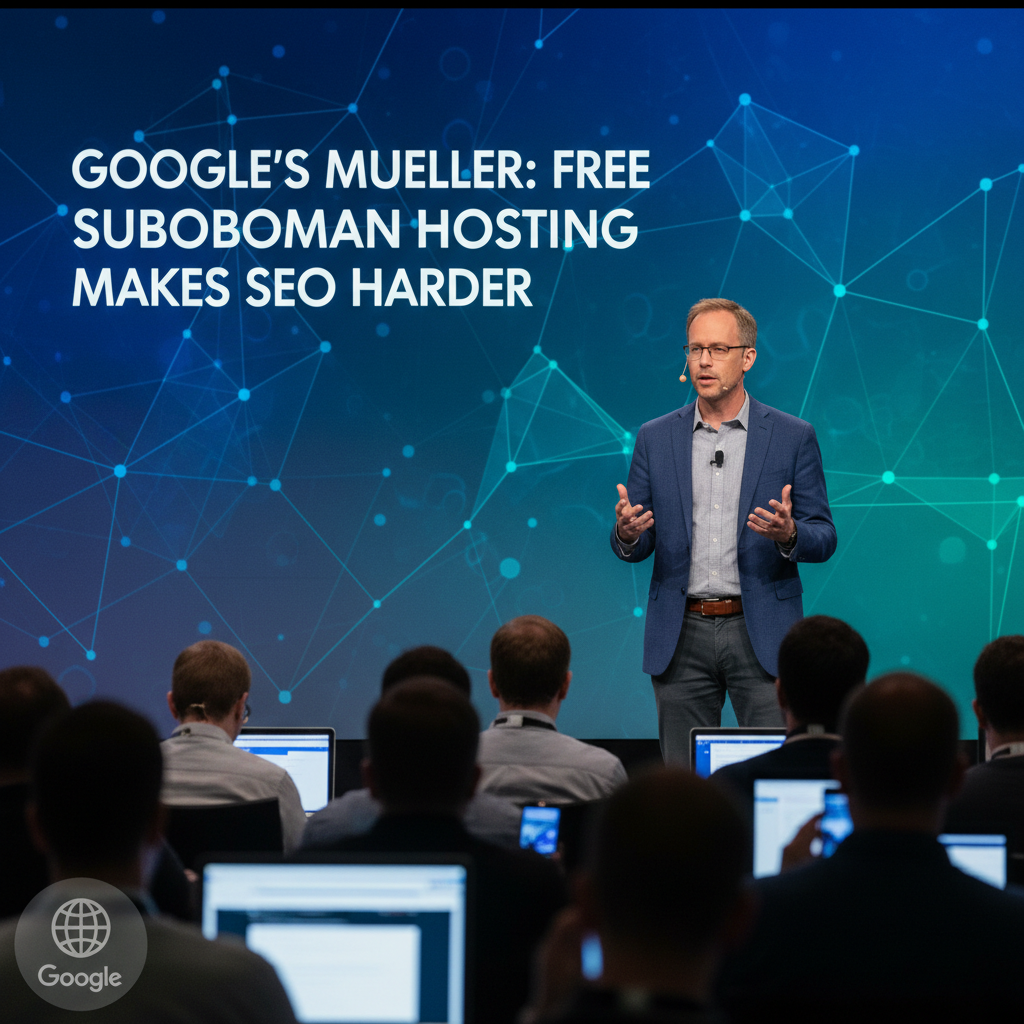
Why Free Subdomain Hosting Sabotages Your SEO
Starting a website on a tight budget can make free hosting seem appealing, but this choice can cripple your long-term success. **Free subdomain hosting** often harms your **SEO** by associating your site with low-quality content, a problem highlighted by **Google’s John Mueller**. This guide explains the risks and presents a better strategy for building your **website ranking**.
The Hidden Risk of Free Domain and Hosting Services
The primary issue with using a free subdomain (e.g., `your-site.freeplatform.com`) is what experts call the “bad neighborhood” effect. These platforms serve as a **digital infrastructure platform** for thousands of users, and they frequently attract a high volume of spam, scams, and low-effort websites. According to **Google’s John Mueller**, your high-quality site becomes a “problematic flatmate” by association.
Even if your content is excellent, search engines may struggle to differentiate your legitimate work from the surrounding digital noise. This association by proximity can damage your site’s credibility before it even has a chance to earn any. Google’s algorithms are designed to assess trust, and being part of a domain known for poor quality is a significant red flag.
Why Your ‘Digital Neighborhood’ Dictates SEO Success
Think of your website’s domain as its physical address. A reputable address lends credibility, while a questionable one raises suspicion. When you use a free subdomain, you inherit the reputation of the parent domain. If that domain is overrun with spam, it taints your site by association, undermining your efforts to improve **search visibility**.
This means that even if you perfectly implement all the fundamental SEO techniques, your progress can be severely limited by your hosting choice. While learning the basics of optimization is essential for any new site, it’s crucial to understand that a poor foundation can make all that work meaningless.
A Better Strategy: Focus on Community Before Rankings
For new websites entering competitive niches, trying to rank on **Google** from day one is often an uphill battle. Instead of prioritizing immediate **search visibility**, Mueller suggests a more effective approach: direct **community building**. If you are confident in your content’s value, your first goal should be to get it directly into the hands of your target audience.
- Promote Directly: Share your articles and pages on social media, in relevant online forums, and through email newsletters.
- Build an Audience: Focus on creating a loyal group of followers who visit your site directly because they value what you offer.
- Let SEO Follow: As your site gains direct traffic and establishes a reputation, its authority will grow. This sends positive signals to search engines, and your **website ranking** will naturally improve over time.
This community-first approach builds a sustainable foundation for growth, proving your site’s worth through genuine engagement rather than just algorithm-chasing. The following video details effective **SEO** strategies specifically for new websites looking to gain traction.
Frequently Asked Questions (FAQ)
What is free subdomain hosting?
Free subdomain hosting is a service where a company allows you to create a website that exists as a subdivision of their own domain. For example, instead of `yourbrand.com`, your address would be `yourbrand.hostingcompany.com`. While it costs nothing, you don’t own the domain and are subject to the platform’s reputation.
Why does Google penalize sites on free hosting platforms?
Google doesn’t explicitly penalize all sites on free platforms, but it struggles to trust them. Because these platforms are often abused by spammers, Google’s algorithms may have difficulty distinguishing high-quality content from low-quality content on the same domain, which can negatively impact your search visibility.
Is it ever okay to use a free subdomain for a website?
A free subdomain might be acceptable for temporary projects, personal experiments, or a short-term portfolio where search engine ranking is not a priority. However, for any serious business, blog, or long-term project, investing in your own domain is critical for building authority and SEO success.
How can a new website get traffic without ranking on Google?
New websites can generate significant traffic by focusing on direct channels. This includes promoting content on social media platforms (like LinkedIn, Twitter, or Instagram), participating in relevant online communities and forums (like Reddit or Quora), building an email list, and engaging in guest posting on other established sites.
Conclusion
While the allure of free **domain and hosting services** is understandable, the potential damage to your **SEO** is a cost too high for any serious project. By associating your site with a “bad digital neighborhood,” you risk making it invisible to search engines. The expert-recommended path is to invest in your own domain and prioritize **community building**. By fostering a direct audience first, you create a powerful foundation for sustainable growth and long-term **search visibility**.