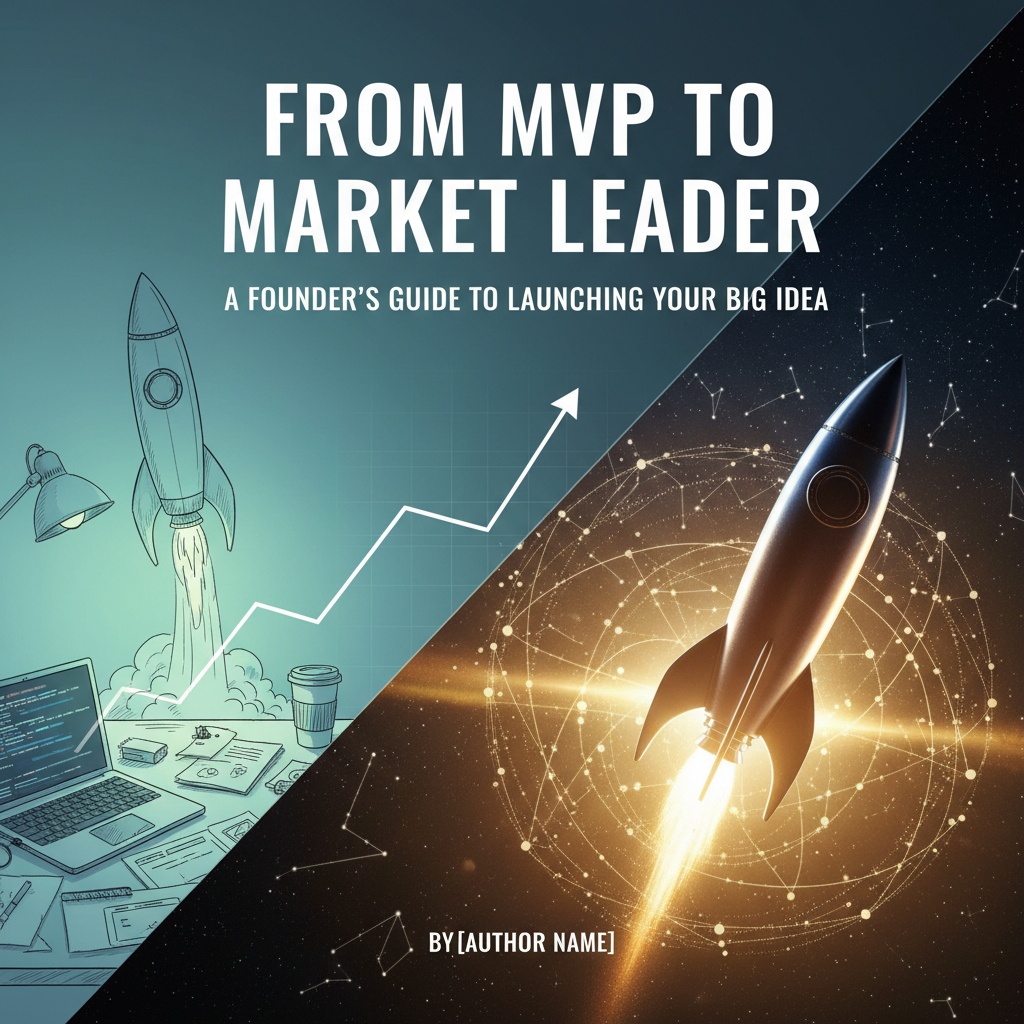
MVP Launch Strategy: A Founder’s Guide to Success
Transforming a brilliant concept into a successful business is a monumental challenge. A Minimum Viable Product (MVP) provides a strategic roadmap, allowing startups to launch smarter and faster. An MVP is the most essential version of your product, built to solve a core problem for early customers and validate your business idea with minimal risk. This guide breaks down a powerful MVP launch strategy, illustrated by the incredible journey of Jing Gao’s Fly By Jing.
What is a Minimum Viable Product (MVP)?
A Minimum Viable Product, or MVP, is a version of a new product that allows a team to collect the maximum amount of validated learning about customers with the least effort. The primary goal is not to build a perfect, feature-packed product from day one. Instead, it’s to launch a functional prototype that addresses a core user need. This approach allows entrepreneurs to test their fundamental business hypothesis—”Will people use and pay for this?”—before investing significant time and money into full-scale development. An effective MVP simplifies your initial business strategy by focusing resources on proving that a market for your idea exists.
A Step-by-Step Guide to Your MVP Launch
Following a structured process is key to a successful product launch. This framework, inspired by the Lean Startup methodology and the success of brands like Fly By Jing, helps you navigate the journey from idea to initial traction.
Step 1: Validate Your Idea with Market Research
Before writing a single line of code or mixing any ingredients, you must confirm that a real market need exists for your solution. For Jing Gao, this market research was organic; her experience running underground supper clubs revealed a strong desire for the authentic, complex Sichuan flavors missing from the Western market. Your research should aim to identify a similar gap or an underserved audience whose problems you can solve.
Step 2: Define the Core Problem and Focus on One Innovation
A successful MVP solves one specific problem exceptionally well. Identify your target audience and the primary pain point you are addressing. Jing Gao’s initial customers were the diners who had powerful reactions to her homemade chili crisp. The problem she solved was the lack of access to genuine, high-quality Chinese condiments. She focused on a single “layer of innovation”—her Sichuan Chili Crisp—instead of an entire product line. This focus makes your value proposition clear and easy for early adopters to embrace.
Step 3: Plan and Test Your MVP for Market Demand
How can you be sure people will buy what you’re building? You test demand first. A pre-launch campaign is a powerful tool for validation. Jing Gao used a Kickstarter campaign as her proof of concept, a move that confirmed market interest beyond her immediate circle. The campaign was funded on its first day and ultimately secured her first 1,000 customers. This validation provided concrete evidence that she was creating a product people were eager to pay for, significantly de-risking her product development.
Step 4: Build, Launch, and Gather Customer Feedback
Your MVP launch is the starting line, not the finish. Once your product is in customers’ hands, your most important job is to listen. Authenticity was Jing Gao’s guiding principle; she developed the product to her own exacting taste, believing that what was real and personal to her would resonate with others. This commitment became a cornerstone of her brand building. The initial customer feedback, whether positive or critical, is the fuel for your next iteration. Continuously listen, learn, and refine your product to better serve your customers.
From MVP to Market Leader: Scaling Your Startup
A successful MVP provides the momentum needed for sustainable growth. For Fly By Jing, the validated concept and loyal customer base built through Kickstarter created the perfect launchpad. By remaining true to the authentic vision that made the MVP a hit, Jing Gao scaled her brand from a niche online project to a pantry staple available in over 12,000 retail stores. This demonstrates that a focused, well-validated start is the most effective engine for scaling a business empire. Authenticity and product-market fit are not just launch tactics; they are foundational pillars for long-term success.
Frequently Asked Questions (FAQ)
What is the main goal of a Minimum Viable Product (MVP)?
The main goal of an MVP is to test a core business idea and gather validated learning from real users with the least amount of resources. It’s designed to answer the critical question: “Is there a real market need for this product?” before committing to full-scale development.
How “minimum” should an MVP be?
An MVP should be “minimum” in terms of features but “viable” in terms of function. It must contain just enough features to be usable and solve at least one core problem for its target audience. The key is to deliver value to early adopters while avoiding unnecessary complexity and cost.
Can a physical product, like in the food business, have an MVP?
Absolutely. As the Fly By Jing case study shows, the MVP concept applies perfectly to physical products. An MVP for a food business could be a single product (like one sauce), sold at a farmer’s market, through a small online store, or via a crowdfunding campaign like Kickstarter to test demand before mass production.
Conclusion
The Minimum Viable Product framework is a powerful tool for any entrepreneur, demystifying the path from idea to market. By focusing on a core solution, validating your concept early, and building with authenticity, you can significantly reduce risk and create a product people genuinely want. As the story of Fly By Jing proves, a well-executed MVP is not just about launching a product—it’s about starting a movement. Trust your vision, start small, and get ready to grow.